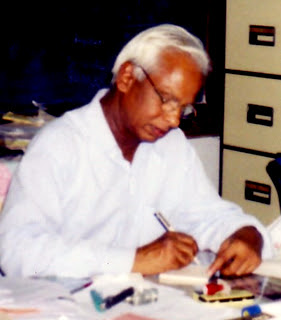
When I retired from IIT Kanpur in
2004, a couple of my younger colleagues, who wished me well, told me that the
time had come for me to “enjoy life”. And they gave content to that expression.
What they said is something like the following: “eat well, enjoy your food, eat
out at least once a week, take long walks morning and evening, generally take
care of your health, go for pilgrimage and on secular travel too, especially
abroad, see the programmes you want to watch on TV, read two or three
newspapers a day, a good time-pass reading, and whatever else interests you,
try to avoid reading anything from an academic point of view, give time to the
family, play with your grand children and the like. Theirs was a dissenting
view. At that time, the norm was different; those who retired sought equivalent
assignments at similar Institutes or universities. In fact, getting such an
offer from such an institution was viewed as a recognition of one’s standing in
one’s discipline, especially in the case of the faculty of the Humanities and
Social Science Department and the Science Departments. The reason for
specifying these departments is that faculty members can be compared with their
counterparts in some of the best universities in our country. Finding a
teaching job at an Institute of Technology wasn’t difficult for the retiring
faculty of the engineering departments. Those were the days when there was a
proliferation of colleges and Institutes of technology in the country. A former
IIT faculty member was welcome in whichever place he chose to work.
I recall a colleague of mine saying this about
a professor in my (Humanities and Social Sciences) Department who was retiring
and was hoping to get an extension: “ Why is he asking for an extension? If he
thinks he is good, he should find a job for himself at a good place.” I know my
colleague didn’t like him and desperately looked forward to his leaving the
Institute, but the logic of the observation can hardly be faulted.
A young colleague of the Civil
Engineering Department explained to me the meaning of superannuation. “From now
on, you are not going to be at a certain place at a certain time of someone
else’s choice. No longer would you have to walk through a thick fog to teach a
class at 8 AM or attend some boring and pointless administrative committee
meeting.” This freedom can be thought of as part of the “enjoy life” idea.
A few months later, sitting next
to me, a warm-hearted fellow traveller in his forties told me during a flight that
since my sons were settled in life, I should make sure I don’t save anything
from my pension: one month over, one month’s pension should be over. I should
spend money on travelling, visiting my relatives, eating out at the best
restaurants, etc. “You must enjoy life”, he told me (what remains of it, I
thought), closing this topic and moving on to another.
During that time, I once ran into
a former colleague of mine at the Delhi airport, who asked me pleasantly what I
was engaged in those days. He was from the Department of Mechanical Engineering.
I said that I was working on a
fifteenth-century Odia version of the Sanskrit Mahabharata. His response was
spontaneous and genuine. “ You are doing the right thing”, he told me, “that’s
the kind of books you should read at this age”, he said. His words were not
from the “enjoy life” perspective, as were those of the others, but from a
modern version of the vanaprastha perspective, when life’s goals must change,
and so must the aspirations. Behind his observation was surely the traditional idea
that reading religious texts lifts the mind from the mundane.
In short, what all these opinions
and suggestions amount to is that post-retirement, one must not do what one did
while in service.
Whatever might be the merit of
these well-meaning suggestions, I must confess I didn’t try to follow any of
them. I had superannuated but not retired. Unlike my ten colleagues who
superannuated from IIT Kanpur that year, I did not take a faculty position,
although I had a couple of offers. I joined a research Fellowship at the
Central Institute of Indian Languages (CIIL), Mysore, to write a book. Thus, I had not reached the stage of following
the advice of my well-wishers and the suggestions regarding how to live a good retired
life.
All the same, I knew that
implementing the suggestions would not be practicable, and not just for me. For
example, consider the idea of giving time to the family. Needless to say, it applies
to those who go to stay with their son. Now, one has time to give, but there are no takers. Young people are busy,
as we were when we were young. And they have to negotiate with a more difficult
world. So, they take care of your needs and try to make you feel comfortable in
your new situation, but it is too much to expect them to have leisurely conversations
with you, the kind of conversation you want and need. Then, there are hardly any
common topics for the same. What interests them is unlikely to engage you, and what
interests you is unlikely to engage them. The world is not the same for us. I
left behind my world of twenty-seven years one night to board a train for Puri.
I had no inclination or energy to enter a different world and be at ease there.
Anyway, this was not just my problem. Most of those retired people I meet
during my walks in the apartment working space travel abroad to spend some
months with their sons or daughters, who, they say, have little time for them
and even fewer things to talk about with them. As for spending time with the grandchildren,
they are busy with their schoolwork and homework, and they do not have
sufficient time to play, let alone spend time with their grandparents.
Morning and evening walks are
fine, but if one lives in an apartment in a metropolis, then the walking space
is limited and fixed. There is no opportunity for novelty. Those who you run
into are the same people, but one doesn’t feel like sharing anything with them.
They are familiar to you, but at the same time, distant from you. As for
travel, it is expensive if you want to have a hassle-free journey. Apart from
this, careful and detailed planning of the journey is a must. This was taken
care of by the host during the service period. It is one thing when the host is
going to receive you at your destination; it’s quite another when there is the
hotel taxi instead. This is no problem for those who enjoy travelling. During
my job period, I travelled quite a lot, but it was for work, and I enjoyed
that. One attends a seminar, gives a guest lecture, participates in an important
academic meeting and the like, and goes sightseeing with the host and other
visitors at the event, after the work is over. I never enjoyed travel for
travel’s sake. I knew I would hardly find it agreeable to do so
post-superannuation.
Now, let’s leave these mundane
matters here and focus on something else. What exactly does this expression
really mean? If I remember correctly, it was only when I superannuated that I
received this expression. So let me start by saying that it is a feel-good,
valedictorian expression with no real content. “Enjoy” is a beautiful word. It
is near-onomatopoeic for me. When I utter the word to myself, I get a taste of comfort
in my mouth. Now, one “enjoys”, in the sense of “relish”, a mithai paan of Ram
Ashrey in Lucknow, butter chicken or if one is averse to the idea of cooking a
chicken, dal makhani of Moti Mahal in Old Delhi or golap jamu at Bikalananda
Kar’s sweet shop in Cuttack. One enjoys a football match, a film, a book, visiting
a ruin, a bit of trekking, watching sea waves rise and break, gossip, a
conversation, writing personal letters, or the company of a friend. While some
enjoy cooking fancy dishes, some love raising flowers. The world is full of
resources for human enjoyment. But life is clearly not of the same category as
these. It does not have the same relation with the “enjoyer” as, say, the
mithai paan. The enjoyer enjoys because he (she / they) has life. The dead
cannot enjoy. So how can one enjoy life, which is inseparable from him?
Now, language is not governed by
logic but by coherence, and coherence is not a concept restricted to the real
world, but covers possible worlds and imaginary worlds, as well. And, language
brings into existence things that are not permissible by logic. Hence,
Coleridge’s “sunny pleasure domes with caves of ice” has poetic, or in other
words, “linguistic reality”. The same holds for Shelly’s “…the tangled boughs
of Heaven and Ocean”. In the same way, in “enjoy life”, language creates the separation
between the enjoyer and life, and makes the latter the object of the former’s
enjoyment. H.W. Longfellow did the same when he wrote “We can make our lives
sublime”. So, one’s life is one’s slate on which one writes one’s feelings,
thoughts and experiences, and that is the content of one’s life. Once life
becomes an object to be enjoyed by the “enjoyer”, then one could understand the
expression “enjoy life” as advice to do things one likes. Needless to say, “the
things” have to be understood as the socially and culturally acceptable things.
What my friends at IIT Kanpur
told me can be understood from this perspective. One must withdraw from a busy
schedule and hard and stressful work. Since one cannot abandon work, one must
do easy work, work that keeps one busy but does not stress out. “Easy work”
would mean, in the present context, teaching foundational courses and writing
textbooks rather than doing research. “Research” here refers to high-level
research, because research is necessary for textbook writing or writing books
that present technical knowledge for non-technical readership. With respect to
working with deadlines, a friend of mine, a Computer Science faculty member at
the University of Hyderabad, put it so well: “Let the deadlines die.”
Interestingly, no one but Brij
Lal, Office Assistant in the Department of Humanities and Social Sciences, to which I belonged, asked me not to be
dependent, especially on small things. I would ask him to help me do some small
things, for instance, putting the pins in the stapler. “You must learn how to
do it before you leave. Who will do such things for you?” He was concerned. He
taught me how to do it. In addition to his work in the office, he made tea for
the people in the Department. I used to take about ten cups of tea a day. I
used to work in my office till 7.30 or sometimes 8 in the evening. After 6 PM,
he would just refuse to give me tea. It was not good for me at my age, he would
tell me. When time to leave the Institute came, he told me to reduce my tea
intake and avoid sugar or sugar free tablets in my tea. “You have not looked
after yourself well. You must be more responsible. If you take care of
yourself, you will remain fit and will not have to depend on others.” Avoiding
dependence on others was the main, almost the only, thing he had to tell me
about how to live my retired life. Isn’t being independent in the above sense
part of the idea of enjoying life? Enjoying life is not merely about “doing”
but about “being” too.